In an era of new age grifts and metaphysical marketing schemes, fairy tales supply spiritual solutions through symbols more powerful than we remember.
The story of Snow White is harsher than the version most of us know. In the Brothers Grimm’s first edition of Children’s and Household Tales (1812), the evil queen is not an interchangeable “stepmother”, but her biological mother. This shocking twist begs the question: how can a mother be the source of such harm? That question struck me the first time I read that older text. We find an easier story in the “wicked stepmother” because stepfamily tensions feel explainable; a degenerate mother is harder to name. This story demands we face the possibility of an evil inside the home. Snow White warns us of an aspect of the mother archetype, what Carl Jung called “The Devouring Mother”. This figure shows up in our lives in many guises, and the story’s deeper meaning has the power to help children recognise and resist that dynamic.
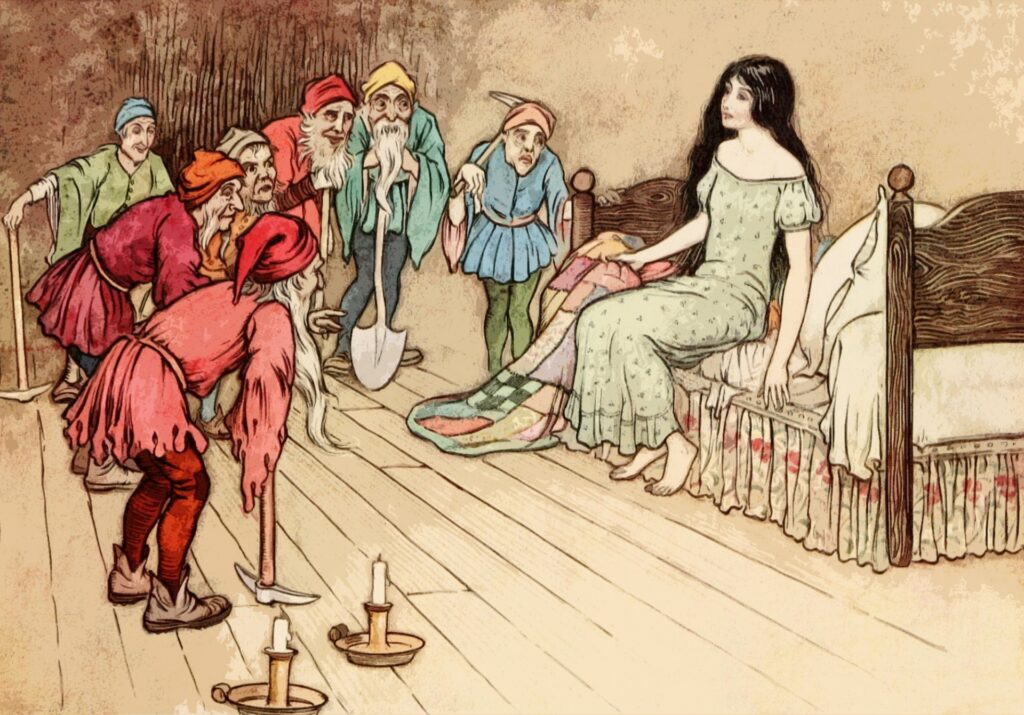
Snow White’s story is one of misfortune, initiation and perseverance —a classic arc where good triumphs over evil. At its beating heart are the seven dwarfs: supporting Snow White on her journey to overcome the evil mother. I don’t think the story could have happened without the seven dwarfs. They are the key to the story — they must be key to the deeper meaning. Since numbers are widely understood to have symbolic meaning, let’s start with the number seven.
The tale can be framed as “The Relationship Between Number Seven and the Child Under the Care of The Devouring Mother”.
Seven is the number of success: Snow White ultimately succeeds, marrying into a royal household and entering the fairy-tale promise of a life lived “happily ever after”. I read the story as insisting that, under controlling and oppressive family dynamics, one must find a way to succeed.
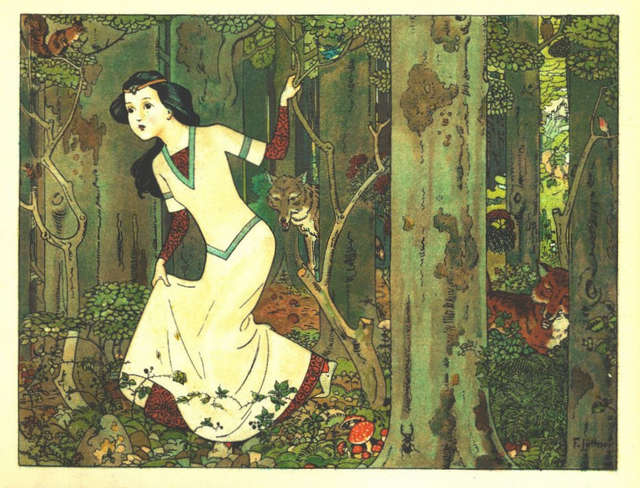
Seven is also a number of spiritual wisdom and fear — and the forest symbolises the same. The forest is where Snow White suffered the most frightening cruelty at the hands of her mother. It was the same setting that allowed Snow White to realise the ways of her mother and gain the wisdom to move forward in life. The episode of apparent death (the poisoned apple) functions as a site of renewal: an interlude that allows time for deep reflection and processing of what has happened. She needed this time of rest to get her head straight. This effort would require great inner strength to overcome the situation and press on to succeed in life. In numerology, seven is also the number of wisdom, knowledge, inner strength and good mind.
Like Snow White, seven represents the experience of hardship — and to overcome hard times, you must endeavour to create a better life for yourself. As one early numerologist advised, those marked by seven should: take an interest in life’s affairs, socialise and cultivate real friendships with those who will foster hidden talent. This advice fits into the arc of the story where Snow White chooses her allies, belongs to a community of helpers, re-enters social life and flourishes in her renewal. Traditional lists associate seven with Being a wife, painting, music, speaking, singing and performing. This fits the tale’s ending where she moves into a sophisticated social circle after her ordeal.
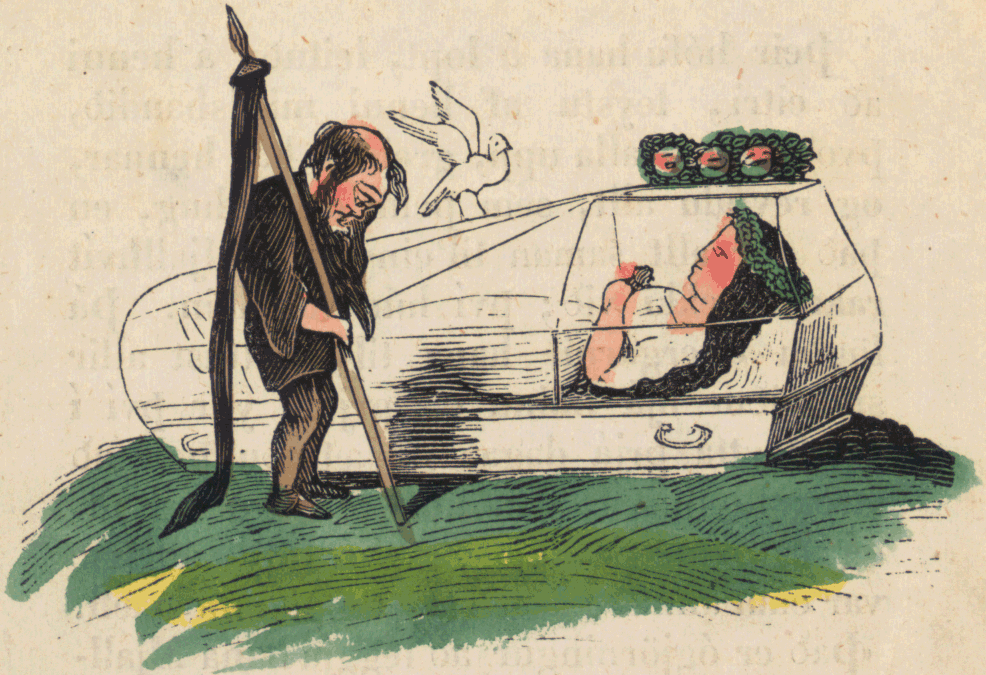
The glass coffin — the transparent cabin of transformation — is “a means of transfer from one state or plane to another”. It is a liminal space: a place of rest, reflection and inner work. What appears as defeat is a place of insight and initiation. Light shows up when fighting through dark times, as the number seven is associated with reading, the intellect, intuition, faith, psychic powers and the seeking of spiritual wisdom. This tale is hopeful and offers serious advice for those who need it the most: deep depression and trauma can be transformed into empathy, purpose and even metaphysical knowledge. Many survivors convert their wounds by finding faith, knowledge, life purpose and care for others.
The genius of this fairy tale is that, symbolically, the whole story amplifies the numerological qualities of the number seven. If you accept that symbols and numbers affect the psyche, Snow White reads like a magnification of the mystical divine seven. Could an adept of old have crafted this tale from a knowledge of the stars? Or did we once live in a culture that downloaded teachings of objective morality into storytelling? Rudolf Steiner called fairy tales “food for the soul”, and the proof of the pudding is in the eating: the nourishment from reading fairy tales is discoverable in practice.
So try this as an experiment. Read the original Snow White — not a sanitised retelling — aloud, regularly, allowing pauses for reflection and questions. Make storytime a ritual: a consistent place, a lamp, a short pause to ask “What would you do?” and a moment to notice how your child reacts. From my teaching experience, repeated reading of fairy tales creates a readiness in children: a charging of the soul that they can call on when real-world testing begins. In this case, Snow White nourishes the wisdom to walk away from toxic feminine control, to take time away to reflect, to find loyal companions, to strengthen the self, and to pursue meaningful goals — in short, oppressive maternal bonds should be broken to do what it takes to live with self-authorship and autonomy.
This article was first published on Sara Cross, “The History Project Digest Magazine”, Vol. 1, Issue 3, December 2025. The full magazine can be purchased here.